Wednesday, December 31, 2003

On Prayer

Sources

  • Michael and Norrisey: Prayer and Temperament — Different Prayer Forms for Different Prayer Types.
    The Open Door, Inc., 1991


  • Paulsell: Rules for Prayer. Paulist Press, 1993 (Out of Print)


  • Vennard: Praying with Body and Soul. Augsburg, 1998
  • Lecture by the Rev. Donald Owens, former chaplain of St. Anselms of Canterbury, University of Oklahoma, Norman, OK
  • Lecture by the Rev. William Spaine, former Vicar of St. James' Episcopal Church, Oklahoma City, OK

Additional Reading


  • Anonymous: The Cloud of Unknowing

  • Anonymous: The Way of the Pilgrim

  • Brother Lawrence: The Practice of the Presence of God

  • Thomas Merton: Seeds of Contemplation


  • St. John of the Cross: Dark Night of the Soul


  • St. Teresa of Avila: Interior Castles


  • Angnes Sandford: The Healing Light


  • Evelyn Underhill: Abba: Meditations Based on the Lord's Prayer. [Note this text is included in the linked item]

Today's Lectio Divina

Reading. John 5:1-15

Meditation.
The words and concepts which stand out for me in today's reading are: obedience, healing, and Law versus love. This last is hard for modern readers to understand. Why were "the Jews" so upset by the man picking up his pallet?

Most Christians are familiar with the Ten Commandments, and are vaguely familiar with the fourth commandment: keep the Sabbath day holy; the text in Exodus amplifies this to say that we are not to labor on this day,
For in six days the Lord made heaven and earth, the sea, and all that in them is, and rested the seventh day: wherefore the Lord blessed the seventh day, and hallowed it.
(1928 Book of Common Prayer)
Most of us consider that we have fulfilled that Commandment by not going to our regular day job on Sunday. But the Pharisees, and many today as well, take that injunction to do no labor very literally and very seriously. In the time of Jesus, it was even "illegal" to drive an animal-drawn cart on this day — to do so would have caused the animals to labor. A handful today will not even drive a car to church, but will walk instead.

About the only persistence of this understanding of the holiness of Sunday in modern America are in certain "blue" laws. For example, here in Oklahoma it is illegal to sell hard liquor on Sunday. Once upon a time, all businesses were closed; today, it's only liquor stores and bars (even bars within restaurants). Originally, this was an application of the injunction against labor on Sunday. Today, I suppose, it preserves the "holiness" of the day by preventing people from easily getting intoxicated.

My interpretation of today's story is that Jesus considered the healing of one person to be more important than the Law or the traditional application of the Law. So, our challenge today is to ask how we may have allowed our application of Biblical Law to get in the way of healing. Are we prepared to drop our understanding of a given Biblical Law in order to be healed? Do we bar others from our faith communities because those others do not observe Biblical Law? Do we shun the stranger because s/he does not adhere to social norms?

Prayer.
Blessed Jesus, Divine Lover,
open my eyes
to see you in the heart
of each person I meet.
Blessed Jesus, Perfect Teacher,
open my ears
to hear your Spirit
moving through the world.
Blessed Jesus,
touch my hands and my feet
to feel you in the rose petal
to feel you in the sandy beach.
Blessed Jesus, open my nostrils,
let them discern the you and not-you
among the oleaginous smells of the city.
Blessed Jesus, open my mouth
and I sing forth your praise;
may I taste you in my morning coffee
as much as in the wafer & wine.
Blessed Jesus, Divine Healer,
   open my third eye
   open my inner ear
   open my secret heart
that I may perceive you in the soft place
where the light & the darkness divide
where the trees meet the sky,
clapping their hands,
where the horizon of this world
meets the infinite reaches of your eternity.

Contemplate. When have I made the Law, or tradition, more important than love and healing?
oleaginous (o-lee-AJ-uh-nuhs) adjective
1. Containing or producing oil; relating to oil.
2. Marked by excessive and false earnestness; ingratiating.
[From Middle English, from French oleagineux, from Latin oleaginus (of the olive tree), from olea (the olive tree).]
Copied from A Word a Day

Ideé d’jour

Only the hand that erases can write the true thing.
— Meister Eckhart, theologian (c. 1260-1327)

Tuesday, December 30, 2003

On Prayer, Part Four
Contemplative Prayer

The following is based on a presentation made by Jim J—, MD
History
Jim began his presentation with some history. First, some personal history of how he first learned of this prayer form. As a true child of the 60's, Jim first encountered the concept of contemplative prayer through the Beatles:
Turn off your mind, relax and float downstream
It is not dying, it is not dying

Lay down all thoughts, surrender to the void
It is shining, it is shining

Yet you may see the meaning of within
It is being, it is being
“Tomorrow Never Knows,” John Lennon, Revolver, 1966
Note that Lennon later claimed this text was inspired by the Tibetan Book of the Dead. The Beatle better known as "the religious one", George Harrison, later wrote:
Try to realize it's all within yourself
no one else can make you change
And to see you're really only very small
and life flows on within you and without you.
“Within You, Without You,” George Harrison, Sgt. Pepper's Lonely Heart's Club Band, 1967
Both these texts were inspired by Eastern mysticism, and introduced Jim to the idea that God was all-present (imminent).

The major world religions all have some form of monastic tradition — even the Jewish religion had a monastic tradition until about the 12th century. These traditions have encountered an experience of the divine which was beyond words (alogos); that is, not speakable. At the same time, these traditions have affirmed the truth that the divine is imminent; that is to say, currently around us and capable of being experienced and perceived. Contemplation is the attempt to experience that which is beyond words by being fully present to the moment.

Method
One begins by seeking a master. The path of contemplation is a risky path to walk without a guide. If you currently a member of a community of faith, it would be wise to seek someone who is mature in his or her faith to support you as you begin this discipline. It would be best if this person also practices contemplative prayer, but if no such person is available, it may suffice to find a person who is at least receptive to this prayer form.

Now, it must be affirmed that we humans find it very difficult to keep our minds empty for more than a very few seconds at a time. So, one begins with what Jim calls the "subtractive" method. That is, one strives to screen out most stimula by focusing on only one. For this step, it is good to have some self-awareness as to which of the five senses is strongest for you. The master may facilitate the process of discerning this; a very close friend or spouse may also have insight as to whether you are primarily visual, auditory, etc. Whichever of the five senses you favor is the one to focus on. Jim is primarily auditory, so he focuses on a very simple tune — in fact, a chant from the Episcopal tradition which is based on the breath. I am primarily a verbal or visual person — so I focus on a repeated phrase (as I have previously described) or a simple mental image (e.g., the Celestial Rose burning near the "third eye").

If you find it difficult to focus on one thing (sound, visual, etc), try a common relaxation/self-hypnosis technique: very slowly instruct each muscle of your body to relax, beginning with your toes, then your feet, and so on up your body. When successful, this technique will lead to a very deep state of relaxation, where the Eternal Now may be encountered.

As you become aware of thoughts intruding during this time, take note of them. Early in your practice, you may want to write them down. Typically, people are replaying past events or are planning future events. The former may indicate any number of emotions (sadness, guilt, joy); the latter may reflect worries. In either case, defining the types of thoughts likely to distract you ironically gives you power over those thoughts.

Finally, the physical location you choose is important. A house of worship would be an obvious choice. There are also what the Celts called the "soft places", that is, those liminal physical locations where the veil between this world and next world is very thin. Examples would include the Isle of Iona, off the coast of Scotland, the circle at Stonehenge, and the "songlines" of the Australians. One need not travel far to find such a place — I have heard, on good authority, that Quartz Mountain in Oklahoma is a "soft place." Indeed, any place considered sacred by indigenous people is likely to be a "soft place", where one may be especially receptive to the Eternal Now.

It is possible to create a sacred space in your home. What is important is that this space be set aside in some fashion. That is, this will be a physical area you don't normally enter except to pray. This space won't "feel" sacred at first. But, given a regular discipline of praying in this space and keeping it "set apart", you will begin to be aware of Holiness while you are in this space.

Some wonderful and scary things can happen when you become open to the divine in this fashion. One may lose control of his or her body — for example, I tend to unconsciously rock when I am deep in prayer. One may feel his or heart burn, as Luke describes the encounter on the road to Ephasus. One may encounter truly frightening things. For example, Jim experienced horror, pain, and loss when he prayed on the site of the Wounded Knee Massacre. This is the reason it is very important to have an elder to guide you in the process. This person will remind you that one does not pray to receive signs such as rocking or a burning heart; one prays to encounter the divine.
This concludes my series on methods of prayer. I hope to have the reading list for this series posted by tomorrow morning (Dec. 31, 2003).

Today's Lectio Divina

Reading. John 4:46-54

Meditation.
I am tempted by signs & wonders,
so much so that I often invent them

I remember the wedding
how earth and heaven
were united in one still moment
like a lightening flash

I remember hearing stories
of light filling a room,
of mothers rising from deathbeds

I believe it is possible
I mean, I want to believe

Do I come at the healing hour?

And what I hear
is a sign & a wonder
It is a diadem of light
placed upon my heart
It is a rare pomegranite seed
carried by birds to my child
The child will grow
to be another light
not overcome by darkness.

Prayer.
May I be wary of signs & wonders
May I trust the light in my heart
May I be wary of self-regard
May I trust the Spirit's guidance
May I walk the path
   breath the eternal
   live the Word
Always be born anew
Always begin again
Always walk in beauty

Contemplation.
Jesus' response in the cited scripture seems like a nonsequitor: "You won't believe unless you see signs and wonders." And, because it seems unresponsive, it also sounds judgemental. In other words, it sounds like Jesus' is saying: "Geez, you people just won't believe unless I do tricks for you." It's unclear in this translation whether Jesus means people like the "royal official", or people in general. The notes in my Revised Standard version report that the plural form of the second person pronoun is being used in the original Koine Greek. Which suggests that Jesus is speaking to us as well as that official.

The cited passage begins with the comment: "This was the second miraculous sign that Jesus performed ..."(Jn 4:54, NIV). The writer of the Gospel understands it to be a "Book of Signs", which the reader is asked to believe without having personally witnessed them (see Jn 20:29). This seems contradictory: in one breath, Jesus seems to be condemning our need for signs and wonders; in the next breath, the gospel writer cites this event as a sign.

Perhaps Jesus' statement is not a judgement. Perhaps it is a recognition of the human condition: because of our physicality, we need outward signs and wonders to stir our heart and soul to belief. Humans are physical creatures, and we tend not to accept an experience as "real" unless we encounter it through our personal senses. We hear Sunday School stories, but if these stories are not echoed somehow in our personal lives, we are unlikely to maintain a lively and robust faith.

It is a good practice, which I have learned through the writings of Joseph Campbell, to think of these stories as mythic. That is, stories which echo patterns typical in human existence. My task, in considering these stories, is to make a connection in my own life.

For example: when have I needed healing? When have I experienced it? When have I felt forgiveness? When have I experience New Birth?

So: the task for today is to keep my eyes open for modern "signs & wonders" which alert me to an experience of the divine. The additional task is to believe even if I can't recognize those signs.

Postcard: 29.Dec.2003

Playing solitaire at 3 a.m.
the cards fall as in a dream
I still don't win
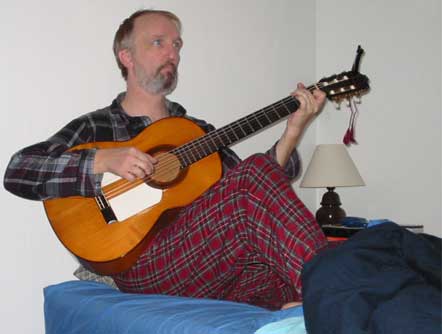
I realize not much matches in all this. The pj top clashes against the lounge-pant bottom. The text of the poem clashes against the picture (a rare view of your correspondent). I guess that's what happens when the poet awakes at 3:30 in the a.m. "Official" postcard version of this will be posted early next week. By the way, the picture is currently titled "Portrait of Early Morning Song", and has been subjected to limited editing (e.g., reduction of red eye).

Another Web Publication!

Your correspondent has been published in the latest Virtual Occoquan. This is my second publication in that worthy web-based journal. The poem, "America, the Lost", originally appeared in this space on December 11 with the working title of "6:45 a.m." It would seem I do my best writing early in the morning, confirming LC's opinion that I am a "morning person."
By the way, don't give up hope on the "Centemplative Prayer" post: I've got the notes right here, and will be typing them up this morning. Have a new "postcard" poem to post, and today's Lectio, which I hope to have done first.

In other words, if all works out as planned, you should see the "Contemplative Prayer" post near the top of today's entries, if you come back late this afternoon. Because, you understand, the entries appear in the reverse order in which they were posted.

Monday, December 29, 2003

Teaser: Contemplative Prayer

I expect to have the final installment of my series on prayer posted later today, or early tomorrow. I'll also be posting a reading list for this series.

Yesterday's Lectio

Reading. Isaiah 61:10 – 62:3

Meditation.
aurora of morning
rings my brow
like Yeats' faery fire

gather winter clouds
wrap about my shoulders

a carpet of pansies
guide my feet

i stand between
yesterday and tomorrow
between starlight & dawn

a thin line of light appears
Venus is the opening doorway
celestial fire still proceeding

Mars is in descent
and will preserve his secrets

Venus ascends
dancing with the water-bearer
joined by Diana along the rim
of the Cold Moon's waning crescent

the door opens:
i am the bride
i am the husband

the earth spins:
i am the child
reborn with each passing shadow

i am adopted
of forest, field, and pavement
i am registered
among the lost tribes

i am walking through the doorway
my fleshy armor dazzling
the pen of peace in my hand
the compassionate heart
blazing through my ribs

i depart darkness' wisdom
and enter the light of revelation

Prayer.
Holy Child, be born in me each day
Let me begin anew in each second
Divine Mother,
I give thanks you have adopted me
I sit patiently before your instruction
Spin my nerves through your delicate fingers
Weave my neurons
into a new design
Sew compassion into each pore
I am silent upon my bed
Teach me, Holy Lady,
to be your Holy Child.
So Be It.

Meditate.
How to feed the divine born in me this day.
The reference in the first verse is to William Butler Yeats' "The Song of Wandering Aengus". The reading from Isaiah was the Old Testament lesson assigned for the prinicpal service of the first Sunday following Christmas Day.

Sunday, December 28, 2003

Unconscious Mutterings

from Luna Nina
  1. Seeker:: pilgrim
  2. Mirror:: face
  3. Fire:: heart
  4. Goblet:: wine
  5. Empty:: full
  6. Secrets:: lies
  7. Defense:: offense
  8. Hatchet:: murder
  9. Vapour:: fog
  10. Ministry:: homage

A weekly game, discovered through Michael Wells.

Ideé d’jour

The sum of human wisdom is not contained in any one language, and no single language is capable of expressing all forms and degrees of human comprehension.
— Ezra Pound, poet (1885-1972)
I have a great deal of respect for Pound. Whether or not he was insane is debatable, although as a brilliant person he was especially susceptible to insanity. As a purist, and elitist, he was possibly more vulnerable to the lure of fascism. Indeed it's hard, sometimes, to read his poetry, poetics, and thoughts without remembering that he broadcast incredible anti-semitic screeds in support of Mussolini and fascism.

Hard to forgive him that, without believing he may have dived a bit off the deep end. On the other hand, it's hard to forget that he helped T.S. Eliott find his voice, and helped patch together the sprawling mess which eventually became The Waste Land. It's quite amusing, picturing Pound making notes in crayon on a work which would become an epic of the mid-twentieth century.
Perhaps an application of the Pound quote would be my favorite trope, "Many rivers flow into the same sea." Or Blake's great assertation: "All Religions Are One."

Friday, December 26, 2003

Boxing Day Thoughts

Tea Bag Wisdom
Life is an adventure of forgiveness
— Norman Cousins (1915-1990) [author of Anatomy of an Illness as Perceived by the Patient]
See also Fr. Bojangles' reflections on how we might celebrate Christmas all year long.
The Preacher's Wife reminds us that today is Boxing Day and St. Stephen's Day. Curious we should celebrate the feast of the first martyr in the church the day after Christmas. But, it may echo the let-down Fr. Bo talks about.

How can we "Strike for Christmas on Earth"? Walk in beauty. Breath in the spirit. See the divine in each face. All that Golden Rule stuff that seems so beautiful and impractical. Can we live each day in this coming year as if it were Christmas Day? The skeptic, who sees himself as a realist, would say "no". I agree with Fr. Bo, who suggests that kindness is our natural tendency. "Me-firstism" is taught, and un-natural.

So be it.

Thursday, December 25, 2003

walk the poem

It is time
sweep the porch
clear out the cobwebs

Time to walk the precincts
of this poem
explore the haunted avenues

Time to explore the vowels
the hidden chambers
between the sounds

Sweep your forehead
crawl forth from your womb
awake to crystal blue morning

Stride forth from dead language
feel new sounds echo
from your throat's tender stops

Wander on
through metaphoric avenues
the dazzling porticoes

It is time
this poem awaits

Wednesday, December 24, 2003

Poetic Lectio

For some time, I have wondered whether the discipline of Lectio Divina might be applied to poetry. This may seem heretical, but consider: both poetry and religion use the language of metaphor. Religious texts of all the world's religions use this language. From the Tao de Ching to the Koran to the King James Bible — the metaphorical language of poetry sings through.

In his appreciation of the poetry of Lorine Niedecker (Rosebud, Issue 28, 2003, pg. 120) John Lehman writes that we look to poetry "for inspiration and consolation and expression of our feelings. Poems do this through extensive use of metaphor." Wouldn't we say the same of religious texts? Lehman goes on to suggest that we devote twice as much time to reading a poem as we do prose because "we give each line of poetry more 'weight' and each word of its line more significance than we do . . . words of prose." I believe this would apply to our religious language, as well.

Lehman then gives us some direction on "How to Make a Poem [Our] Own":

  1. Read it aloud. Don't worry about meaning or vocal interpretation. Just read, three or four times through. Let the words reverberate through your body
  2. Don't get bogged down in the rhythm or rhyme of a specific line in a poem
    1. note line breaks
    2. note syllabic stresses within a line — what feelings do those stresses suggest?
  3. Note words at beginning of lines
  4. Be sensitive to rhyme and hints of rhyme
  5. When reading aloud, emphasize verbs and interpret verbs with more exageration than normal
  6. Identify the poem's images — be sensitive to ways the poem may appeal to all "the senses five".
So, applying both Mr. Lehman's suggestions, and the classic guidance of the Lectio Divina, I would suggest this manner of reading a poem:
  1. Read the poem, as suggested by Lehman. Read it out loud several times. Make a mental note of turns of phrase, or images which especially strike you
  2. Meditate on those words, phrases, and images. Don't try to intellectually interpret, just hear the words, picture the images, breath the rhythm of the lines in & out.
  3. Respond. Now, write something which plays out those words, phrases, etc. Don't worry if what you write is better or worse than the original work. And, once again, don't try to interpret the original poem as a professor would. Rather, allow those words, images, and so on, to lead you to a place which may (or may not) be very foreign to the original work.
  4. Contemplate the conversation between your creation and the original. How do they intersect? How do they diverge?
Well, I did this to an extent in writing my responses to L.C. Bolivia postcard poems. However, it seems a worthy experiment for me to try more intentionally in the near future. Stay tuned.

"How to Make a Poem Your Own: An Appreciation of the Poetry of Lorine Niedecker" appears in Issue 28 of Rosebud, a quarterly literary magazine.

Ideé d’jour

When nations grow old, the arts grow cold and commerce settles on every tree.
— William Blake, poet, engraver, and painter (1757-1827)

On Prayer, Pt. Three:
Physical Prayer

Note: This presentation was given in an Episcopal Church, and thus will reflect that tradition and its prejudices.
I.

It's ironic: in the Episcopal Church, we are accustomed to using our bodies in worship. Perhaps more so than many modern Christian traditions. Those of us raised in the church are familiar with the formula:
Sit for instruction
Stand for praise
Kneel to pray
Yet, a recent sit-com reminded me that Episcopalians are perceived as stiff and stodgy. So much so, they can't use the technical terms for certain below-the-belt body parts.

How is it possible for us to use our bodies in worship so often, yet still be out of touch with them? I suspect this has much to do with these actions having become rote; we perform them without reflecting on their meaning.

For example, many of our liturgical actions reflect a monarchial view of the deity. We geneflect when entering the pew,
just as our British cousins reverence the king or queen. In this way, we are Sunday monarchists and weekday democrats.
II.

So, I first echo the advice Jane Vennard gives in her book Praying With Body & Soul (1998, Augsburg): pay attention to the physical posture you currently assume when praying, then change it. If you normally kneel to pray, try standing. And before you start saying words, pay attention to your body: how does standing alter your relationship with the divine?

When you feel ill, or at other times, you may pray while lying in bed. Indeed, the psalmist speaks of lying in bed and
calling on God. Perhaps you may perceive yourself to be cradled in God's arms even as Mary cradled the infant Jesus.
III.

In her book, Ms. Vennard discusses how anything may become prayer. This happens through intention and attention. Intention is why we do something: we may, for example, choose to walk for our health. Or, we may chose to walk as a form of prayer, seeing Christ as our companion. Walking may be a way to slow ourselves down, so we may be more attentive to creation.

This last point, of seeing the creator through creation, directs us to how our attention may be "seized" by external stimuli. It may be 'the flower in the snow', or it may be the friend who holds you as you weep. Any moment, any brightness, any darkness, may surprise us — and awaken us to God's presence.
IV.
Place your hand in front of your mouth and breath. Do this for a few minutes. Then place your hand on your heart. Be aware of your heartrate in this moment. These are both automic responses we control to a certain degree. That is, we may consciously slow down our breathing, which will concurrently slow down our heart-rate.

This relates to the Eastern Orthodox tradition Fr. Ron del Bene calls "breath prayer". The best known is described in the
spiritual classic The Way of the Pilgrim: "Lord Jesus Christ, Son of God, have mercy on me, a sinner." My personal breath prayer is more brief: "Lord Jesus, make me whole." The mechanics of this are that I mentally say the first half of the phrase as I inhale, and the second half as I exhale.

There is no particular magic to this phrase; I would recommend a phrase 8–10 syllables long, simply because this is equivalent ot the average human breath. Address the divine in the way most comfortable and meaningful for you, then make a simple request which reflects where you currently are in your spiritual journey.

When I attended a series on breath prayer several years ago, the teacher gave us small sticky dots. The idea was to put dots places we normally look during the day: our wristwatche, our dashboard, our mirror, etc. This "cue" will remind you to say your breath prayer. You may want to consider other cues: waiting on line, or in traffic, etc.

What you may discover, through this constant repition, is that the words begin to lose their literal meaning. That's ok. As this happens, the rhythm of the words write themselves on your heart, enter your psyche, re-shape your soul.
V.

Our group then did a prayer walk, to more fully experience our physical bodies at prayer. This is related to walking a
labyrinth, a tradition which began in the Middle Ages as a substitute for those who could not make the pilgrimage to
Jerusalem. A labyrinth may look like a maze, but it has an important difference: one cannot get lost in a labyrinth, for the path in is also the path out.

For the purpose of our exercise, we walked the regions of the St. Nicholas Chapel, a space about as big as the average suburban living room. We began at the baptismal font, at the rear of the chapel, walked down the alley between the two sets of pews, up around the altar, back down the alley, around a little bend, then back to the baptismal font and our pews. I led this procession, each step being about half the length of my foot (~2-3 inches). I instructed our group to be very aware of the muscles used, the weight shifting from the back of the foot to the ball, and any sense of imbalance.

Afterwards, participants shared their experiences. One lady told us she prayed for God's protection over our group as we walked. A gentleman was reminded of his time serving as an acolyte, how those dignified processions also seemed prayerful. A couple of members shared how walking disturbed their sense of physical balance. Another gentleman shared his realization that human beliefs are ever shifting.
Next week: Contemplative Prayer.

Good News for Lenny

Brother Dave mentioned there had been good news for Lenny today. Well, I wasn't sure which Lenny he was referring to, there being a couple I'm obsessed with.

But I had a feeling he was referring to Lenny Bruce. And, sure enough, Google News led me to this article about Lenny Bruce receiving a posthomous pardon for his obscenity charge in New York. Well, it does Lenny little good, though it's always nice to see "the State" recognize its mistakes. Hopefully, the same attitude will apply to modern day artists such as Eminem. Personally, I'm not a big fan of racist and misogynistic rap music (actually, I think "rap MUSIC" is an oxymoron), but I would not seek to suppress that form of expression.

Interestingly, the other "Lenny" I follow is also in the news: Leonard Cohen has donated artwork to Canada's War Child's annual Christmas card. Here's the original image.

Absolutely no connection between the articles at all. I think it's cool that Brother Dave's off-hand comment would lead me to both places.

Tuesday, December 23, 2003

Teaser: On Physical Prayer

Part three of my series "On Prayer" is in progress. At this point, it is represented by four pages of barely readable scrawl in a regular size spiral notebook. I shudder to think how long that will be in this space — a couple of screens-worth, I imagine. I shall seek ways to break the text up, in hopes of making it more bearable.

Consider this a fair warning. Lengthy post coming, soon.

Today's Holy Reading

Reading.  Luke 1: 26-38

Meditation.
Most of us don't get angels;
most of us don't get burning bushes
or voices on the mountain.
We don't even get sacred cd roms
plotting our life's path.
Your servant strives to listen.
I lie a-bed in the early morning watches
and await your voice.
But you are silent.
Oh, sure, I feel the burning in my heart —
sometimes I dream I'm on the Emmaus road.
I lie a-bed,
cradle myself in you,
but you are silent.
All I hear is the house breathing.
Well, I also recall the echo of my own voice as I read your word.
Then I recall how others have responded to that voice.
The voice I believe you gave me.
They say my voice leads to prayer.
But you are silent.

Prayer.
Holy Mother,
cradle me in your arms.
Teach me a mother's
unconditional love,
then teach me how to share it.
Son of Man
with the Holy Heart,
teach me true compassion.
High Holy One,
teach me
the secret voice of thunder.

Contemplation.
What angels have spoken to you without your hearing them as angels? How do you discern the voice of God?

Sunday, December 21, 2003

Today's Lectio Divina

Reading. Luke 1: 39-56
Meditation.
I read the song of Mary
as I listen to the psalm of Coltrane
Can I speak such language of praise?
Can my heart leap up
like the messenger in the womb?
I am a lowly servant
who is daily being born
I could not stop reading Mary's song
for her voice rises from the page
Her voice sings of my loneliness
Her voice strikes down the pride of my heart
Her voice teaches me strength.

Prayer.
Blessed Lady,
let me be born anew
through you.
Beloved Mother,
store my life in your heart.
Holy One,
hold me in your arms;
I will snuggle your cheek with my own
then will I rest in peace.

Contemplation. Today is the shortest day of the year. We meditate on Mary's short song. We meditate on how the divine is daily born in us.

May we grow in humilty
rather than pride;
in service, rather than strength;
in questions, rather than answers.

Later this morning I will walk the path & breath the spirit. May the door of my heart open and echo the Holy Name.

So be it.
The referenced "psalm of Coltrane" is John Coltrane's A Love Supreme. Listen. Learn. Ponder these things in your heart.